We have contacted everyone on our current waitlists and offered them priority on the West Cambie Waitlist for a projected September 1, 2013 opening.
The general public may start waitlisting now on our website and by clicking on the West Cambie button.
More information regarding an Open House will be posted here once we have a confirmed opening date.
Please contact info@richmondchildcare.org if you have any questions.
One step closer to new child care spaces for Richmond!

Thursday, 9 May 2013
Friday, 12 April 2013
West Cambie Children's Centre Ribbon Cutting
You may have read THIS article in the Richmond News today.

We need to correct the information that while the child care centre is substantially completed it is NOT finished, is NOT opening now and we do NOT yet have an opening date.
At the moment the Developer is completing the interior, the City is reviewing the requirements for occupancy, cubbies and playgrounds need to be installed, and a license has to be granted to operate.
These activities will take another couple of months at least.
We are still hopeful it will be open this Summer (2013) but it looks to be closer to September at this point.
As soon as a date is confirmed we will open the waitlist. Until then we suggest you get on the SRCC waitlist as those on it will be given priority for the new spaces at West Cambie (12 infant/12 toddler/25 3-5's and preschool to start - Out-of-school care may start later).
Please call Nicky 604-214-3490 if you have any questions on the development.
For waitlist please call Jennifer at 604-231-0870

We need to correct the information that while the child care centre is substantially completed it is NOT finished, is NOT opening now and we do NOT yet have an opening date.
At the moment the Developer is completing the interior, the City is reviewing the requirements for occupancy, cubbies and playgrounds need to be installed, and a license has to be granted to operate.
These activities will take another couple of months at least.
We are still hopeful it will be open this Summer (2013) but it looks to be closer to September at this point.
 |
| April 11, 2013 |
Please call Nicky 604-214-3490 if you have any questions on the development.
For waitlist please call Jennifer at 604-231-0870

Wednesday, 13 March 2013
Block Play
Unit Blocks Turn 100!
REPOSTED FORM EXCHANGE EVERYDAYMarch 13, 2013
"In 1913, Caroline Pratt was a young teacher working in Manhattan. Having grown up on a farm, she understood about hands-on learning. But she realized that city children were deprived of much of the practical know-how that seemed natural to country kids. This concern, coupled with inspiration from the Froebel course she’d just completed, led Pratt to design the Unit Block. Its mathematical proportions and open-ended nature blend perfectly with Froebel’s philosophy.
"Because there is no 'correct' use of blocks, children have no fear of failure. Imagination guides their play, and each experiment encourages the next. While observing block play, adults can almost hear a child’s thoughts! Block play allows children to re present ideas in concrete ways — preparing their minds for more abstract forms of symbolism, such as written language. Block play supports knowledge and understanding of the world as children create miniature environments and experiment with concepts like design, symmetry, and balance. Architect Frank Lloyd Wright attributed his success to an early love of block play."
REPOSTED FORM EXCHANGE EVERYDAYMarch 13, 2013
Arriving at one goal is the starting point to another.
-John Dewey
Community Playthings has observed that 2013 marks the unit block’s 100th birthday:-John Dewey
"In 1913, Caroline Pratt was a young teacher working in Manhattan. Having grown up on a farm, she understood about hands-on learning. But she realized that city children were deprived of much of the practical know-how that seemed natural to country kids. This concern, coupled with inspiration from the Froebel course she’d just completed, led Pratt to design the Unit Block. Its mathematical proportions and open-ended nature blend perfectly with Froebel’s philosophy.
"Because there is no 'correct' use of blocks, children have no fear of failure. Imagination guides their play, and each experiment encourages the next. While observing block play, adults can almost hear a child’s thoughts! Block play allows children to re present ideas in concrete ways — preparing their minds for more abstract forms of symbolism, such as written language. Block play supports knowledge and understanding of the world as children create miniature environments and experiment with concepts like design, symmetry, and balance. Architect Frank Lloyd Wright attributed his success to an early love of block play."
Tuesday, 26 February 2013
What is Play?
ExchangeEveryDay
February 26, 2013
"A natural drive to play is universal across all young mammals. Children from every society on earth spend time playing. Why? Because play is a crucial vehicle for exploring and learning, developing new skills, and connecting with others. From an infant’s first smile to a preschooler’s careful construction of a tower, children use play to engage with and learn about their world. Play has key neurological, cognitive, socio-emotional, and physiological benefits for children’s health. Most importantly, play is the way in which children form loving, trusting relationships.
"People often think of play in terms of specific ‘play activities’ such as tag, soccer, or playing in the sandbox. In contrast, they think of work in terms of activities like raking leaves, cooking, cleaning, or doing homework. It is our belief that any activity, as long as it is done with a playful approach, is play. In other words, it’s not about what you do, it’s about how you do it. Playfulness is the expression of our natural drive to freely and joyfully explore, engage, and connect with the surrounding world."
February 26, 2013
The future belongs to those who believe in the beauty of their dreams.
-Eleanor Roosevelt
"Historically, play
has been viewed as a frivolous break from important endeavors like
working and learning when, in fact, a child’s ability to fully and
freely engage in play is essential to their learning, productivity, and
overall development," observe Steve Gross and Rebecca Cornelli Sanderson
in their article, "Play is the Way," in the Beginnings section of the September/October 2012 Exchange magazine. They continue:-Eleanor Roosevelt
"A natural drive to play is universal across all young mammals. Children from every society on earth spend time playing. Why? Because play is a crucial vehicle for exploring and learning, developing new skills, and connecting with others. From an infant’s first smile to a preschooler’s careful construction of a tower, children use play to engage with and learn about their world. Play has key neurological, cognitive, socio-emotional, and physiological benefits for children’s health. Most importantly, play is the way in which children form loving, trusting relationships.
"People often think of play in terms of specific ‘play activities’ such as tag, soccer, or playing in the sandbox. In contrast, they think of work in terms of activities like raking leaves, cooking, cleaning, or doing homework. It is our belief that any activity, as long as it is done with a playful approach, is play. In other words, it’s not about what you do, it’s about how you do it. Playfulness is the expression of our natural drive to freely and joyfully explore, engage, and connect with the surrounding world."
Saturday, 19 January 2013
Ig's done!
What took .......
400 4l milk cartons
30 enthusiastic children
5 dedicated teachers
30 milk chugging families
2 months
????????????
Introducing the Igloo


400 4l milk cartons
30 enthusiastic children
5 dedicated teachers
30 milk chugging families
2 months
????????????
Introducing the Igloo


Monday, 14 January 2013
Igloo If you Please
The 3-5's at Bowling Green decided to build an igloo.
For over a month they have been collecting 4L milk jugs.
Everyday little people arrive with as many milk jugs as they could find.
Parents report milk consumption is at an all time high in their homes :)
We washed them and hung them all around the centre as they came in
 And today the day finally arrived that building could begin.......
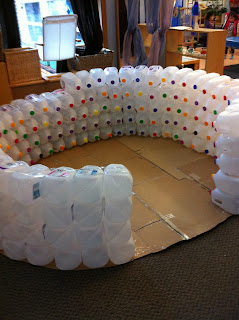


 STAY TUNED!!!!
For over a month they have been collecting 4L milk jugs.
Everyday little people arrive with as many milk jugs as they could find.
Parents report milk consumption is at an all time high in their homes :)
We washed them and hung them all around the centre as they came in


Monday, 17 December 2012
Talking to Children about the Shooting
December 17, 2012
- An Exchange article by Diane Levin: "When the World is a Dangerous Place — Helping Children Deal with Violence in the News."
- A New York Times article, "Tips for Talking to Children About the Shooting."
- Advice from National Child Traumatic Stress Network, "Talking to Children about the Shooting."
- Advice from the National Association of School Psychologists, "A National Tragedy: Helping Children Cope."
- A resource from the U.S. Department of Health and Human Services, "Tips for Talking to Children and Youth after Traumatic Events."
- Fred Rogers' advice from Family Communications, "Helping Children Deal with Tragic Events in the News."
- Advice from the American Psychological Association, "Helping Your Children Manage Distress in the Aftermath of a Shooting."
Subscribe to:
Posts (Atom)